Tags
When the parks and theater come together ~
It’s funny how events connect from different parts of your life and come together in unexpected ways.
So what does a trip to the Florida Everglades, a new friendship with Dorothy, a highly successful biophysicist, and the Broadway smash hit Hamilton have in common? And how has this string of events in the last two months inspired me to write a blog post about an issue facing one of our national parks? Are you dying to know?! Well, I’m going to tell you anyway.
As you may know, I’m a big fan of national parks / public lands and musical theater. Maybe one day the Beaumont Community Players will let me produce: “Park Ranger…The Musical!”. Just picture park rangers tap-hiking while singing about The Appalachian Trail or the biodiversity of The Big Thicket and The Big Cypress National Preserves. Theodore Roosevelt could sing a number called “Antiquities Act” with the Grand Canyon chorus, Woodrow Wilson could do a dramatic interpretation of the signing of “The Organic Act of 1916” that created the National Park Service, and the opening number could be a big Rogers and Hammerstein-style song and dance tribute to our first national park, “Yellowstone”.
Ok enough of that….for now 🙂
I am very grateful to be able to visit national parks and buy theater tickets. On a recent NPCA winter trip to the Everglades National Park with my dear friend Heather, we were asked to give a ride from the airport to a very interesting, savvy, and smart park advocate named Dorothy. One of the best things about my new association with conservation groups such as NPCA is that I’m inspired by people who care passionately about preserving wild, beautiful, historic places – landscapes and public lands that benefit all Americans. Dorothy is one of those inspiring and big picture people. I know Heather, Dorothy and I will be friends for life.

The Three “Alligateers”!
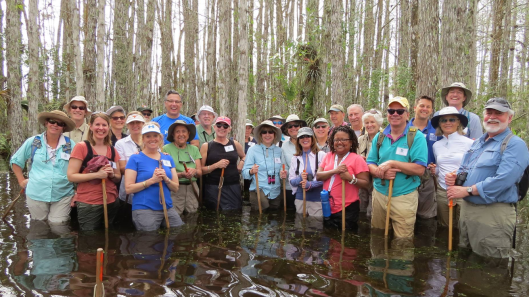
Swamp Hiking in Big Cypress National Preserve with friends from the National Park Conservation Association
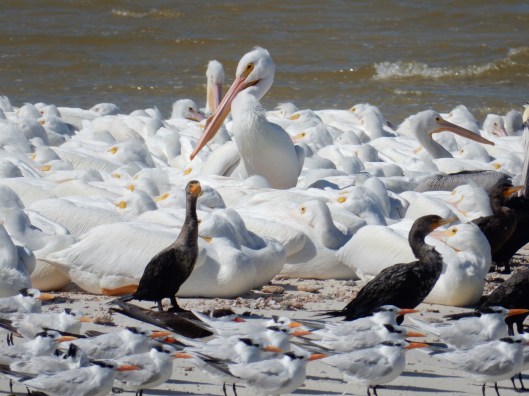
Birds at 10,000 islands at Everglades National Park
Heather and I spent time with Dorothy driving to and from the Fort Myers airport, swamp hiking and boating through the Everglades. In conversations over meals and informal group meetings about latest park news, Dorothy passionately educated us on a personal level about an issue facing Colonial National Historical Park which contains several sites of critical importance in the history of America. Historic Jamestown is where the story of Captain John Smith and Pocahontas actually happened, and where the roots of American government first took hold. Yorktown Battlefield was the site of the Colonial victory over British forces in the American Revolution that would lead to official American independence two years later, and where visitors can still view some of the original earthworks constructed by George Washington’s troops. These two sites are linked together by the 23-mile long scenic Colonial Parkway, specifically designed to limit the impacts of the roadway on the surrounding landscape.
I’ll get back to the aforementioned issue in a minute.
Fast forward 6 weeks. I had the opportunity to see the Broadway musical theater phenomenon – Hamilton! Lin-Manuel Miranda’s brilliant show celebrates the life of a founding father who galvanized, inspired and shaped our newborn nation. It is based on the New York Times bestselling biography of Alexander Hamilton by Pulitzer prize-winning author, Ron Chernow. History comes alive in poetic hip-hop R&B along with some 60’s-influenced music. It’s a history sensation that has fans obsessed. You will want to learn every single biographical historical word. And if you haven’t heard any of the music yet, for the love of God download some immediately! Here’s a clip in the meantime:
Miranda’s artistry communicated the uniquely special and miraculous idea of the reality of freedom and our early American experience. I take for granted this fateful happenstance that these brilliant people, our founding fathers, came together and created the birth of our nation and laid strong foundations of democracy. Hamilton, an immigrant born on the Caribbean island of Nevis, created and implemented a national banking system that is our Treasury department, authored most of the Federalists Papers, founded the Coast Guard and The New York Post, and is now a Broadway Star teaching and re-teaching audiences about our important American history in a very original way.
Snap along to the words below:
“How does a rag tag, volunteer army in need of a shower,
somehow defeat a global superpower?”
How do we emerge victorious from the quagmire?
From the battlefield raising Betsy Ross’ flag higher?”
In Hamilton, the battle of Yorktown is depicted in a song called “Yorktown (The World Turned Upside Down)”, and emotionally captivates the audience and reminds us with clever prose the important meaning of this battle in 1781.
For three days, the Continental and French armies pounded the British lines non-stop. On the night of October 11, Washington’s men began work on a siege trench, just 250 yards from the British lines. Progress on this work could not continue due to British fortifications, Redoubts #9 and #10, which prevented the line from reaching the river. Assault on Redoubt #10 was assigned to, you guessed it – Alexander Hamilton.
Washington’s tactics, as well as the actions of Hamilton, Lafayette, and Laurens, led to a full surrender by British Lt. General, Lord Cornwallis. The title refers to the song played by British bands as they marched out of town following Cornwallis’ surrender.
The lyrics describe what happened after the battle:
Hamilton: We negotiate the terms of surrender
I see George Washington smile
We escort their men out of Yorktown
They stagger home single file
Tens of thousands of people flood the streets
There are screams and church bells ringing
And as our fallen foes retreat
I hear the drinking song they’re singing…
All: The World turned upside down
Take a listen:
Sitting in the Richard Rogers theater, I watched, listened and digested these historic American experiences communicated to me through Miranda’s artful genius. I felt emotionally invested as it punctuated the issue Dorothy discussed with us on that February trip to the Everglades on another level. I am proud that we have a national park that tells this miraculous story on the site where this history actually happened, and I’m motivated to preserve it in my own small way.
We can visit Colonial National Historical Park and see the same landscape as Hamilton did as he commanded troops in the battle of Yorktown. Although we may not have been ‘in the room where it happened’ (that’s another great Hamilton song) or anywhere near the space and time continuum where it all happened – we can see the “view” where it happened…
Unless it is impeded by this:
The Issue:
Dominion Virginia Power has a plan to build 17 giant towers across the scenic James River known as the Dominion Surry-Skiffes Creek Whealton Transmission Line. As National Park Service Director Jonathan Jarvis states in his letter about his concerns for the project to Lt General Thomas P. Bostick, US Army Corps of Engineers, “Running power lines through the landscape where the earliest days of American history were written will forever change the ability of Americans to experience and understand our nation’s earliest days”. In addition, Director Jarvis points out the following in his letter:
- It would be a massive and modern intrusion in a landscape that retains the feeling and appearance of that historical time.
- It would cross directly over the open water route of the Captain John Smith Chesapeake National Historic Trail.
- It would be within sight of Jamestown Island and the Colonial Parkway.
- It would set a precedent for additional development and cumulative effects.
- It would forever degrade, damage, and destroy the historic setting of these iconic resources.
- This is not acceptable for resourses designated by Congress to ensure their permanent protection.
- The NPS is working with state and local organizations to get the Jamestown Island placed as a significant site on the list maintained by UNESCO – the first step to designation as a World Heritage site that attracts millions of visitors from around the world.
- It is a setting that has survived intact for over 400 years.
In addition, Dorothy reminded me of the following:
- Dominion did not significantly take into account energy efficiency measures or renewable energy initiatives in its 2011 analysis to support the project.
- In a recent study of 32 US public utility companies entitled “Benchmarking Clean Energy Deployment: 2014,” Dominion ranked 30, 31 and 32 on three parameters related to renewable energy and energy efficiency.
Endangered Species
Dominion’s project not only threatens the integrity of Jamestown, Yorktown and the John Smith National Historic Trail it could also harm the spawning grounds of the Atlantic sturgeon, an endangered species that can be traced back to the time of dinosaurs, and the habitat of other animals and plants including bald eagles, northern long-eared bats, and a rare orchid known as the small whorled pogonia.
Economic Impact
The project would possibly affect some of the economic benefits that this historic site provides to Virginia’s $22 billion tourism industry with one billion dollars generated by tourism in the Historic Triangle – the three corners being Jamestown, Colonial Williamsburg, and Yorktown.
The Project
As I mentioned, Dominion wants to construct 17 massive electric transmission towers across the James River over the Captain John Smith Historic Trail, as well as 27 additional towers throughout the landscape. A number of these towers are as tall as the Statue of Liberty!
Dominion claims that building these new transmission towers across the James River at the selected location is the only way to provide the necessary power to the Hampton Roads area without having rolling blackouts after the company closes a local coal-burning power plant that will soon be in violation of EPA pollution standards.
The report Dominion is using is outdated. Their proposal is based on electricity use on hot summer days growing 1.9% each year but actual electricity use on hot summer days dropped in 2012, 2013, and 2014. Also, actual electricity use by the area’s military sites dropped 9.8% from FY11-FY14.
Let me say that this is not about being anti-business, it’s about smart, thoughtful business. Let’s not ‘throw away our shot’ (another Hamilton song) to preserve the view shed of this historic place for our future generations.
So if you have read this far and are so inclined here’s what you can do:
Please urge the Army Corps of Engineers to oppose the project.
You can use the information in this blog to do so.
Please address your individual or group letters to:
Lt. General Thomas P. Bostick
US Army Chief of Engineers and Commanding General
US Army Corps of Engineers
441 G Street, NW
Washington, DC 20314-1000
Also, please reach out to your representatives and ask them to push the Corps to oppose the project.
~~~~~~~~~~~~~~~~~~~~~~~~~~~~~~~~~~~
It’s really something special to look back at what you think are unconnected events and see the message. Thank you Hamilton, thank you National Park Service and thank you Dorothy for bringing the two together to make us aware and inspire action in an everyday ordinary way.
A quote from another person who inspires me… Audrey Peterman, author of the book Our True Nature and just sums it all up:
One of the most gratifying things of all is that when I tour some of the places where my ancestors lived or where pivotal events took place, the natural world connects me to the people and the times. Trees that they touched and probably nurtured are still standing, and in many cases I can look out at the same view that they saw and give thanks to all who had a hand in saving it for me.
Oh and Happy Easter from the Hamilton Peeps. Thanks to Eve another Hamilton enthusiast for sending me this:

courtesy of mashable.com
 myordinaryvoice